

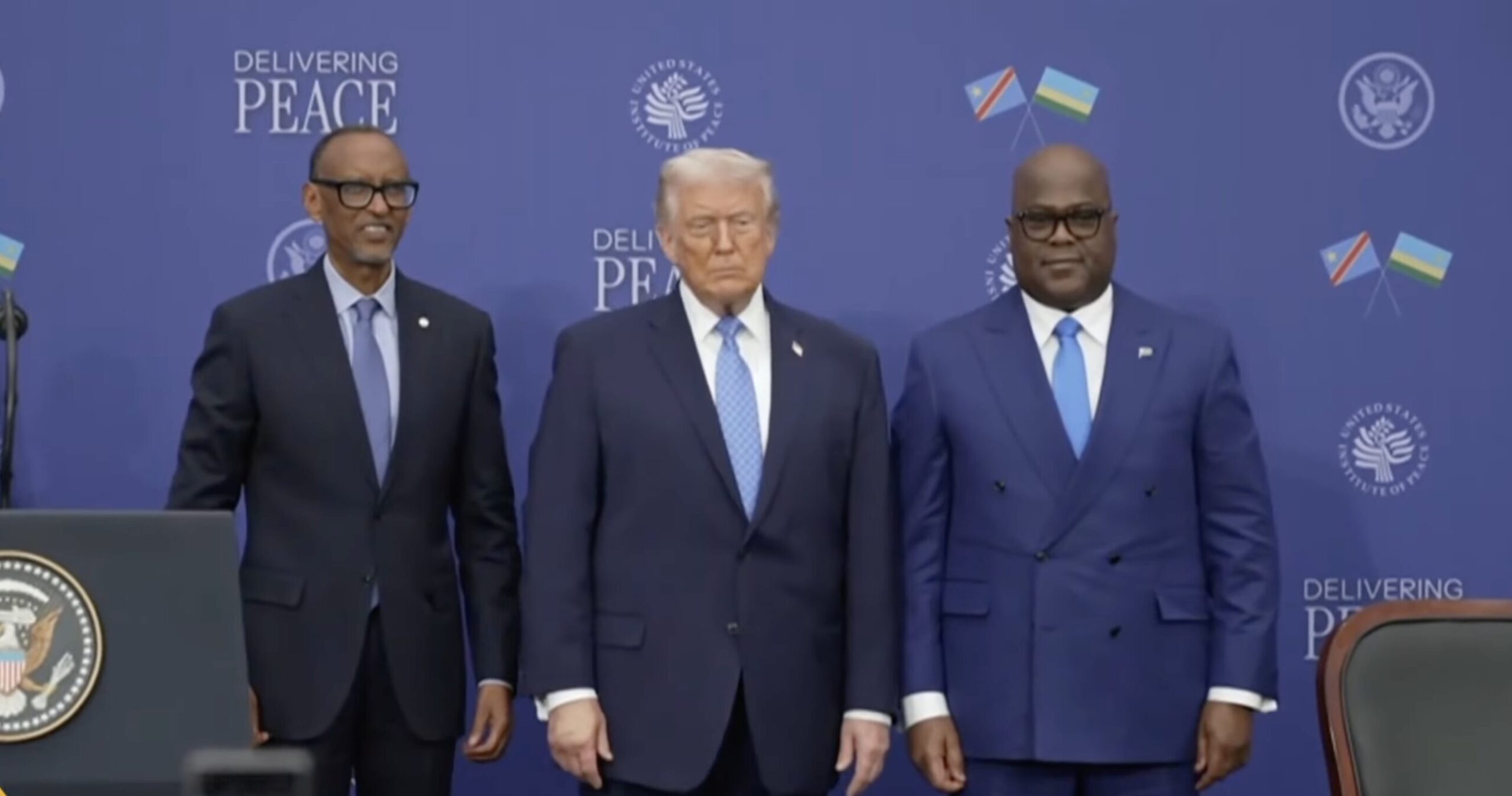
When President Trump brought the leaders of Congo and Rwanda to Washington to sign a peace agreement, many observers treated it as a sudden geopolitical awakening. But Africans knew better. American presidents do not engage Africa—physically or diplomatically—unless minerals, money, or military strategy are at stake. And in this case, cobalt, coltan, and rare earth minerals were the quiet guests of honor.
Trump’s meeting exposed what most administrations try to bury under humanitarian rhetoric: U.S. engagement in Africa is always transactional. What made this moment stand out was the lack of moral preconditions. No cultural lectures. No ideological demands. No threat of withdrawing aid unless African leaders aligned with Western social norms. Just raw interests on the table.
To understand why that matters, we must revisit a history America refuses to confront.
For more than a decade, U.S.–Africa policy under Democratic administrations—Obama-Biden and later Biden–Harris—was defined by cultural coercion. African nations were told explicitly or implicitly: change your laws regarding LGBTQ issues or lose American support. Uganda, Kenya, Ghana, Tanzania, and Malawi were pressured to restructure centuries-old social norms to satisfy Western expectations. Aid, trade partnerships, and diplomatic relationships were leveraged like bargaining chips in a moral negotiation. Uganda became the clearest example of resistance. When its parliament passed a sweeping anti-LGBT law, the United States retaliated with visa bans, public condemnation, and economic threats. Uganda, standing firm, called it “cultural imperialism” and refused to fold. African leaders took note, realizing they had more leverage than Washington wanted to admit.

The most significant example of Western interference came earlier, when Africa took its boldest step toward continental independence. Muammar Gaddafi was not merely the ruler of Libya—he was the chief architect of the vision for a United States of Africa, a federation with a continental military, shared institutions, and most threatening to Western financial dominance, a unified currency backed by African gold. His proposed gold-backed dinar would have allowed African nations to trade outside the U.S. dollar and the euro, fundamentally altering global power dynamics. Within months of advancing that agenda, Gaddafi was politically isolated, militarily targeted, and ultimately assassinated under a NATO operation championed by the Obama administration and Secretary of State Hillary Clinton. His removal was not the toppling of a tyrant; it was the dismantling of Africa’s most ambitious attempt at sovereignty in modern history. And the aftermath speaks for itself: Libya—once one of Africa’s most stable and prosperous nations—is now a fractured state engulfed in chaos, warlord rule, and even a revived slave trade. Obama and Clinton conveniently avoid responsibility for the devastation they helped unleash. Africans have not forgotten. They know precisely what it means: whenever Africa moves toward unity and independence, Western power responds with force.
This historical context serves as the backdrop for Trump’s peace summit. The Washington Accords involving Congo and Rwanda were not just another diplomatic event—they signaled an American pivot back to interest-based foreign policy. Trump did not demand social reforms or cultural concessions. He focused on minerals, security, and regional stability. He treated African nations as strategic partners, not ideological students. Whether intentional or not, this approach aligns more closely with how African nations now expect to be engaged: as sovereign entities, not projects for social engineering.
But here is the truth that should inspire Black Americans: as Africa’s global relevance grows, we have the power to influence its future if we prepare ourselves.
Africa is entering a new era of global relevance. Nations are negotiating mineral rights, energy infrastructure, technological development, and defense cooperation at a scale not seen since decolonization. These opportunities require engineers, geologists, mineral economists, policy strategists, logistics specialists, energy developers, and diplomatic negotiators. African countries would prefer to collaborate with Black Americans—people who share ancestry, cultural ties, and historical connections. But preference does not replace preparedness. Black America at large lacks the technical and institutional capacity to participate in Africa’s modern economic landscape.
We are not producing mining engineers, mineral analysts, energy specialists, infrastructure planners, or teams of skilled diplomats who can operate on the continent. We have no coordinated diaspora investment groups, no collective venture pipelines, no strategic workforce training geared toward Africa’s emerging industries. Meanwhile, China floods the continent with engineers and contractors. Europe sends financiers and negotiators. The United States sends corporations and military advisers. And Black America sends…nothing organized, nothing scaled, nothing capable of entering billion-dollar sectors.
We dominate culture, entertainment, and service labor, but these industries do not build nations or shape geopolitics. To access mineral contracts, cross-border projects, and trade networks, we need technical expertise and strategic capacity, not just cultural influence.
This is not a moral failing; it is a strategic crisis.
Black America is being locked out of the African renaissance because we have not developed the skills, infrastructure, and institutions needed to participate strategically. We have identity but no access, connection but no capacity. The door to Africa is open, but without preparation, we cannot walk through it with purpose.
Trump’s meeting revealed how much Africa has changed—and how urgent it is for Black America to prepare now, or risk being left behind once again.
The tragedy is not that America is partnering with Africa. The tragedy is that Black America is not ready to partner with Africa at the same time.
And unless we confront this reality with urgency, clarity, and unity, we will watch global opportunity pass us by—again.
References
1. U.S. pressure on African nations regarding LGBTQ laws
– U.S. Department of State: Statements criticizing Uganda’s Anti-Homosexuality Act and linking aid/visa policies to LGBTQ rights compliance.
– White House (Biden Administration): Fact Sheet on U.S. response to Uganda’s anti-LGBTQ law (2023).
– Human Rights Watch: Documentation of U.S. and Western diplomatic pressure on African nations over LGBTQ legislation.
2. Uganda’s resistance to Western pressure
– Reuters: Uganda accusing the U.S. and Western nations of “blackmail” over anti-LGBTQ laws.
– VOA News: Coverage of U.S. removing Uganda from trade programs and Uganda’s rejection of “cultural imperialism.”
– Uganda Constitutional Court ruling (2024) upholding major sections of the Anti-Homosexuality Act.
3. Gaddafi’s push for a United States of Africa
– African Union archives: Records of Gaddafi’s proposal for a continental federation and African Union government structure.
– BBC News: Reporting on Gaddafi’s push for a gold-backed dinar and African economic independence.
– Al Jazeera: Analysis of economic motives behind NATO’s intervention in Libya (2011).
– The Guardian: Coverage of Hillary Clinton and the Obama administration’s role in Gaddafi’s overthrow.
– Multiple academic pieces on Pan-Africanism and Gaddafi’s monetary integration plan.
4. U.S.–NATO intervention and the assassination of Gaddafi
– NATO official reports on Operation Unified Protector (2011).
– Hillary Clinton State Department emails released by the State Department, outlining concerns about Gaddafi’s gold currency plan.
– The Guardian & The Washington Post: Coverage of Gaddafi’s capture and killing.
5. Trump’s Congo–Rwanda peace agreement meeting (2025)
– Reuters: Reporting on Trump hosting Congolese and Rwandan leaders in Washington (2025).
– Associated Press (AP): Coverage of the “Washington Accords” and their geopolitical context.
– Le Monde: Analysis of the peace agreement and its significance for regional stability.
– CNBC Africa: Coverage of Trump’s renaming of the U.S. Institute of Peace before the summit.
6. U.S. foreign policy toward Africa under previous administrations
– Brookings Institution: Analysis of Obama-era Africa diplomacy and cultural-conditional aid.
– Carnegie Endowment for International Peace: Studies on Western leverage through human-rights-linked aid.
– Congressional Research Service (CRS): Reports on U.S.–Africa trade and conditional foreign assistance.
7. Africa’s mineral importance (cobalt, coltan, rare earths)
– U.S. Geological Survey (USGS): Global mineral reserves data.
– The Economist: Reports on Congo’s cobalt dominance and geopolitical competition.
– International Energy Agency (IEA): Studies on mineral demand for emerging technologies.
8. China’s growing influence in Africa
– Council on Foreign Relations (CFR): Belt and Road initiative in Africa.
– Oxford University China-Africa project: Research on China’s mineral contracts, infrastructure projects, and engineering presence.
– Financial Times: Reporting on China’s mining stakes in Congo.
9. Skill gaps and workforce issues in Black America
– National Science Foundation (NSF): Data on Black representation in engineering, geosciences, and technology fields.
– McKinsey & Company: Reports on Black economic mobility and workforce participation in advanced sectors.
– U.S. Bureau of Labor Statistics: Demographic representation in energy, mining, engineering, and foreign service careers.
10. Historical patterns of U.S. economic exclusion of Black Americans from foreign policy and global investment
– Harvard Kennedy School: Studies on diaspora economic participation.
– Howard University Department of African Studies: Research on African American absence in U.S.–Africa economic relations.
– Congressional Black Caucus Foundation (CBCF): Reports on Black underrepresentation in international affairs fields.


Leave feedback about this